Love and Dogs
- Gabriella Doty
- Dec 21, 2019
- 14 min read

I met Ann and Ohana II, a yellow lab in a yellow and blue vest, in the Willow Glen Middle School parking lot when I was 14. Ann, the “puppy raiser” was meeting up with my mom for some reason––they worked together at an auditing firm––and I tagged along, just to see the dog. First, we stayed under the shade of the parking lot solar panels, but eventually moved to the grass. Ohana had to “hurry” and August was a hot month and the blacktop was

boiling. School wasn’t out yet for the tweens and teens even though it was for my high school on the adjoining campus.
Sophomore year of high school, I had to start looking for places to earn my community service in order to join an honors society on campus. There were hour requirements for every semester, and I wanted something consistent. After I met Ann, I started attending Tuesday night puppy training classes to help Ann train her next puppy.
Tuesday after Tuesday, hour after hour, I fell deeper and deeper in love with everything about it.
We’ve all seen service dogs at some point, wearing their vests and working hard for their people. We’ve all felt the pull of deep desire to pet the good boys, mixed with the restraint of knowing they are doing important work. We’ve all questioned whether or not that lady really needs her yappy purse dog inside the restaurant for medical reasons.
What most people don’t know is how much work goes into raising even one dog for service.
In 1975, Bonnie Bergin created Canine Companions for Independence, the first organization of its kind, when she came up with the concept of a service dog. Not to be confused with seeing eye dogs, service dogs were trained to help people with mobility issues. Now, they expand far beyond that, helping people with a wide range of disabilities.
Currently, CCI places five different types of service animals: service dogs, for adults with physical disabilities; hearing dogs, for adults who are deaf or hard of hearing; skilled companions, trained to work with either adults or children with a disability through a caretaker; assistance dogs for veterans, for vets suffering from PTSD; and facility dogs, partnered with a facilitator to work in hospitals, courts, schools, and more.
Since their founding, CCI has placed over 6,300 “graduate teams” of people with various disabilities with fully trained service dogs specialized to their needs, free of cost. CCI is a non-profit organization that runs solely on donations, fundraising, and volunteers.
It is estimated that over $50,000 can go in to raising and training just one of these dogs, and very few graduate from advanced training. Volunteers play a number of roles: breeder caretakers of dogs originally raised to be service animals (but seen as the “best in class”––they need to pass on those good genes somehow); puppy raisers, raising dogs from 8 weeks to 18-20 months; and local volunteers who go out and educate their communities about the organization.
Ohana was the third CCI puppy of Ann Weitz’s, and she was just a few weeks away from going to “puppy college,” or advanced training when we first met. Puppy raisers, like Ann, raise and train their dogs from eight weeks until about 18-20 months, at which point the dog gets turned in to one of the six CCI training centers in the US. From there, they spend about six months going through advanced training and extensive evaluation. Some get released from service after a week, some go through all six months and still get released. But if a dog makes it through all of advanced training, CCI begins the process of pairing them with a recipient on their very long waiting list.
Ohana was one of those dogs. The dogs that made it. “Any time I have a dog up in Santa Rosa, I’m checking the weather to be like ‘oh what’s their weather like today’ and ‘oh my gosh, they’re dealing with this.’ But any time I get a call from a 707 area code, I jump on it because I have a dog up there, what are they doing? Are they choosing the dog as a breeder, are they telling me the dog is being released, are they telling me the dog is being spayed?” The only call Ann received about Ohana was the call letting her know Ohana was to be paired.

“Having Ayla hand over the leash to Dustin, who is a year younger than her, had a huge impact on me.” Ann started volunteering when her daughter, Ayla, was four or five. Ayla grew to become increasingly active in the puppy raising process, even looking into taking a puppy in training with her to her high school.
“I didn’t get into volunteering to go ‘And then, when my kids are old enough, they’ll do this, this, and this.’ It was just a byproduct of them being around the dogs.” Ann always had a great love of dogs, and while she was a stay at home mom to two toddlers, she wanted a way to fill her time and a way to give back. She had a nephew the same age as Ayla who was born with a multitude of physical challenges, and this motivated her to research different service dog organizations. She began with guide dogs for the blind and eventually landed on CCI. And when the time finally came to hand over the leash of their first successful, graduated puppy, Ann knew Ayla had to be the one to do it.
For Ann, the most rewarding part was “being a parent and having a physically ‘normal child’ who then had the opportunity to hand the leash off to somebody who needed that dog.” Jack, Ann’s nephew, could still one day be a recipient of one of these dogs. His name was on the waiting list then as it is now.
“It was a selfless act that I didn’t even realize we were bringing our kids into.”
It started a new chapter in their lives. A chapter of “let’s do things for other people.”
“They used to have to drug Dustin to even sit down, to calm down enough to go into the dentist’s office.” Dustin and his mother Shelby were paired with Ohana at the Santa Rosa Training Center in 2014. He has severe autism. “And then with Ohana, I think he was so proud that he was either showing her off or that just having her there was calming him down and they were able to take him to the dentist without any medication.
“Which was huge.”
The first and only CCI graduation I went to in person was the summer graduation of 2018. They usually stream it on Facebook, or you can get a play-by-play from whoever you know that went, because there is always someone you know who went. We were presenting Aggie as a breeder like a rich East Coast teen is introduced to society at a Debutante—top of her class but freshly pregnant.
My mother became the official co-breeder caretaker of Aggie III in late spring. I wasn’t able to come home to meet her until the summer. At this summer graduation I had known her for a few weeks but had already felt a dog-soulmate level connection. It could have been the fact that she was the most well behaved dog I had ever met, save the other fully trained service dogs I had met over my years of volunteering, or the fact that she was the sweetest one, but I knew we would be bonded for life.
The same day, all across the country, all five of Aggie’s brothers and sisters graduated to become fully fledged service dogs. All of the dogs of a litter going into service was a rare feat, and once people found out, we were pestered about the litter that had barely started growing in Aggie. Even though we have no control over where the puppies go. Even though all the puppy raisers asking for one of her pups knew it too.
CCI graduation events can be summed up by the main activity of all attendees—crying. Ugly crying. Crying because you might not see the puppy you raised for almost two years for six months. Crying because a puppy you raised is graduating and being paired with someone who really needs them. We all cry because one of the graduates gives a lengthy speech about how much his dog has already changed his life in two weeks—the amount of time the recipients spend on site learning how to work with their dog.
This graduation was no different. The event was held in a modern church building, and the lobby was filled with dogs and podiums with travel Kleenex bags. One of Aggie’s litter mates was the new dog of the speaker, and she looked exactly like her sister, who, during the ceremony, was laying on my feet to keep them warm. Sometimes I feel selfish that I get to have these dogs love me and take care of me when they could be doing the same and more for someone else. It is hard to remember how important just staying healthy and having puppies is to the success of CCI.
It’s still burnt in my memory, how a room could smell so clean and so dirty at the same time. When Aggie saw us, she came running, much slower than usual because of how violently she was shaking her butt. That’s how we know she is happy, because while her eyes stay in a constant state of looking like they are straight from a close up in a Sarah Mclachlan commercial, her wiggling butt gives her away.
For her first litter, Aggie was selected to participate in a special cognition program. I dropped her off in Santa Rosa five days before her due date and couldn’t see her in person until her puppies were five weeks old.
Every week once a week leading up to our visit, the people taking care of Aggie sent us professional photos of her and her puppies. I was shocked when we showed up that they were so much smaller than I had imagined. Up until that point, I had seen plenty of 8-week-old puppies, but a lot of growing happens very fast.

All of this I knew, but it seems impossible to rationalize when you are distracted by four perfect angel fluff balls hopping around, incessantly biting your toes, and falling asleep literally anywhere they are.
It was excruciating to leave after seeing them for only 45 minutes. People always ask if it’s hard to give the dogs away. Obviously for puppy raisers it’s hard because they’ve spent so long bonding. When Whitney had her puppies at our house it was easy to let them go because after eight weeks you’re done with the smell and the sweat and the mess. It was easy with Whitney’s puppies because we were already in contact with almost all 9 of the puppy raisers. But with Aggie’s first litter, we had none of it. It seems impossible that after three quarters of an hour you can fall in love four times over.
But that’s why I don’t always mention it. People think it’s tragic that we have to give up our dog’s puppies to maybe never see again. Giving them away isn’t the sad part. The fear of not knowing their future and not being able to see how they grow and who they help is.
Whitney VII was a brand-new breeder in need of a home in October of 2018, and we picked her up fully intending to pass her along once the organization could find a caretaker. They asked us to foster her when we arrived to pick Aggie up from her birth at the center. They had run out of room in their kennels and to be honest, we were happy to volunteer. The dogs they chose were always so well behaved, and when you pick up a dog from the center or vet you usually get a brand-new large bag of food for free. We already had one breeder who just had her first litter, but after a few weeks with Whitney we fell in love all over again.
Aggie is the type of dog that only craves love and attention and has plenty of love to give. If she wasn’t chosen to be a breeder, she would have excelled at deep tissue therapy as a PTSD dog or cuddling with people in crisis as a facility dog. Her sole purpose in life is to lay on top of you wherever you sit and stick her nose under the closest blanket or pillow (under your arm will do if neither are available). Whitney, however, snuck up on us.
Silent but deadly.
Aggie fell in love first, and her love created a domino. Before Whitney, Aggie didn’t enjoy being around other dogs—she only liked us humans. We controlled the food, owned the couch, and gave her love. But after having a regular companion to keep her from feeling lonely, Aggie is now more of a social butterfly than Whitney.
Aggie’s love affair with Whitney made my dad fall next. It took him five years to give in to getting one, and after one week with another he couldn’t give them up.
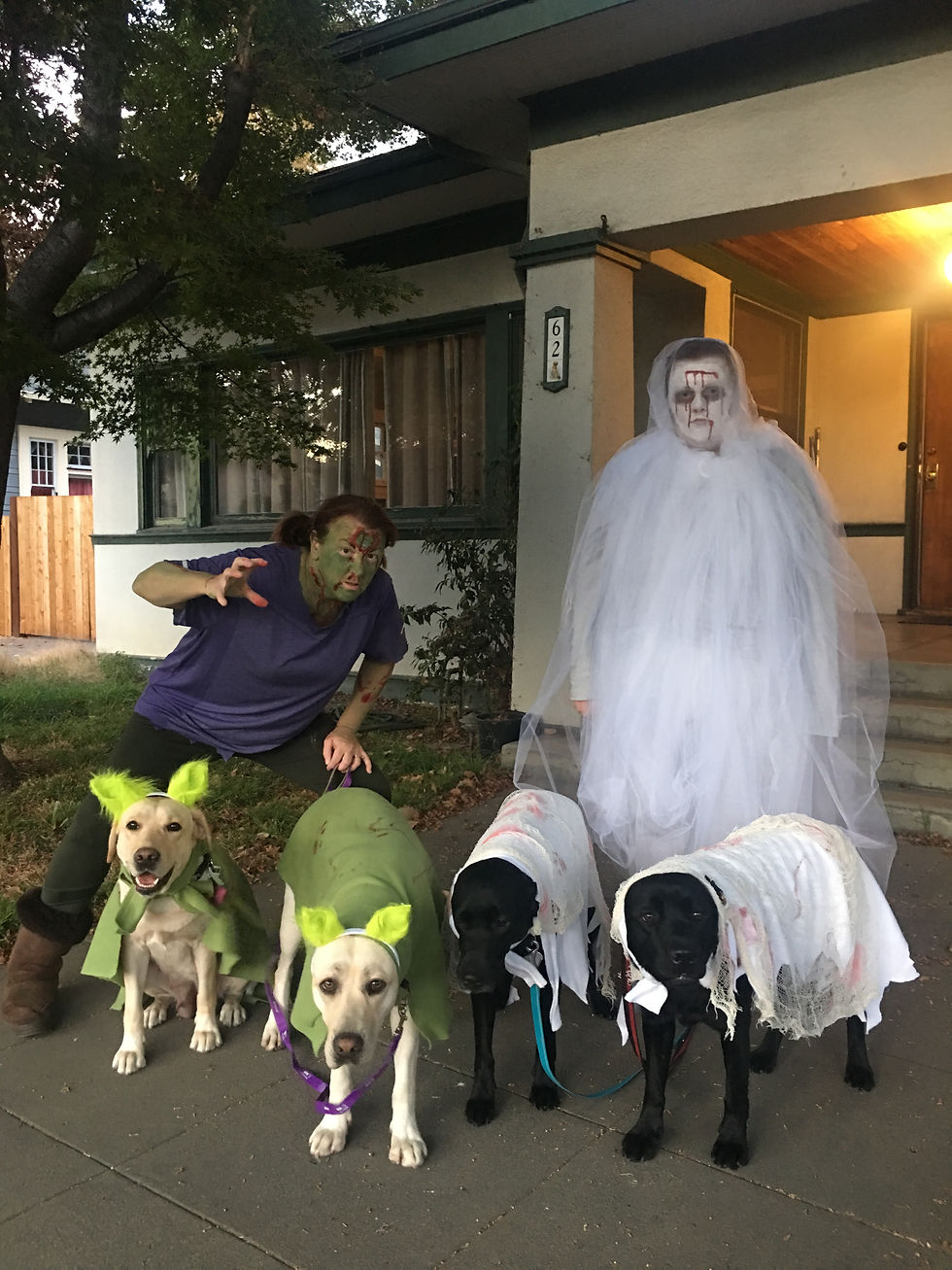
My mom and I fell together after a Halloween party at a nightclub in Downtown San Jose. We took the dogs with us, dressed up as ghosts and goblins, and were the stars of the show. All the drunken rich charitable people ended up rolling around the dancefloor with the dogs, astounded that they were unperturbed by the pulsating music. We won $200 for best group costume, even though I basically just cut fleece ponchos for the dogs. From there on we became a team, and we certainly couldn’t let her leave.
The only time I felt truly scared when taking care of Whitney’s first litter was when my mom and I had to take puppy number four, a five-day old yellow female, to the vet after it was lethargic for hours, only getting up to throw up. My mother called the on call CCI vet and they advised us to take the puppy to the emergency clinic.
She wasn’t latching on to Whitney, so she wasn’t getting enough milk, making her dehydrated and weak. It was raining and cold outside, one of the last showers of spring. The puppies hadn’t opened their eyes yet, and they still moved by wiggling around like worms. Since they were so young, the top priority was keeping her warm enough, especially without the milk to warm her up. My mom microwaved one of her bean filled heat packs, wrapped it in a towel, wrapped the puppy in a towel, and we took off.
On the ride to the emergency vet, we kept the puppy in a tiny crate in the backseat. After a few minutes, I turned around, opened the door of the crate, and kept one hand on the puppy to make sure she was breathing until we arrived.
We checked in under Whitney’s name, as little puppy number four wasn’t named yet and could only be identified by her collar color, neon green. They immediately took her back for some testing, and my mom and I waited in the lobby, eyes locked on that door to the back or distracted by pictures of the puppies we left with my dad at home.

They finally brought her back out to us on a little hot water bottle bed made out of an old children’s sweatshirt. From there we waited to get called back to see the vet, and once we did, we were offered some different options. They would feed her some sugar water, an easy way to solve a puppy’s dehydration, and give her a shot in the skin of her back to hydrate her further. If she failed to latch and feed after that, they prepared a feeding tube kit for us to take home.
Thankfully, it did work, and we were able to get her back home to her mother. It was an emotionally draining day. The fear of losing a puppy is intense, and while stillborn puppies and puppies who fail to thrive are possible, the statistics aren’t comforting in in a moment like that. A moment when you feel responsible.
I thought that would be the worst thing I would have to deal with. Aggie had a couple of stillborn puppies across her two litters, but I hadn’t been there to see them. I thought that maybe since Whitney’s first puppies were all alive, all her litters would follow suit.
I always though the color of death was black, but this week I found out it’s a very dark green. So green it is almost black. And you never want to see the color of death.
I came home for my Christmas break on an eight o’clock fight out of Santa Ana this past Wednesday evening. Whitney was due two days later––Friday the thirteenth. The gestation period of a dog’s pregnancy is way shorter than I expected––62 days. 63 maybe. I mean, this time around I knew that, seeing as it was now my fourth litter of puppies. But it still amazed me that she could create those wiggly little potatoes in just two months, and in two more they would be shipped across the US to their puppy raisers, just as wiggly, not so potato-y.
And so Wednesday night came, and my flight lasted an hour and three minutes. My dad picked me up from the airport with Aggie in the back, fully equipped with her butt-wagging greeting. The drive home from the airport was short, and my dad and I mostly talked about how giant Whitney looked as Aggie peeked her head out next to my head rest. To appease her I would occasionally tilt my head towards her and kiss her snout, after which she would gently nudge my face and lick the air around me.
When we got to the house, I was still a bit shocked at how big Whitney was. She looked like a goat, with great protruding sides. She even followed me around like a goat in a petting zoo, begging me for food everywhere I went.

It was already a late night with my late flight, and my mom had to sleep downstairs with Whitney to keep a constant watch on her as early as 48 hours before her due date. I stayed up as late as I could to keep them company but fell asleep around 1:30 in the morning. Three hours later, my mom came in my room with Whitney and woke me up by saying she was in labor, and then walked away, on the move as Whitney paced all around the house. She told my father too but couldn’t manage to rouse him out of bed at such an early hour.
From there, we started the waiting game. We didn’t wait long, however, as puppy number one was born at 5:01 AM. I was in the garage and my mother was with Whitney in the front yard. Out of nowhere, I heard my mother scream “We’ve got a puppy1”
I scrambled out of the garage and down the hallway, just to have to backtrack when my mother asked for multiple towels. We were both stuck in a bit of a panicked haze, anxious for everything to go right now that the birth had officially started.
After puppy number one was born, Ann started to make her way over to our house to help with the entire process. After she arrived came puppy number two at 5:48 AM, delivered by Ann in the backyard. I was reeling from how fast it all felt, especially as I felt the effects of lack of sleep.
But then it slowed down. An hour and a half passed, the amount of time they ask you to wait before calling the CCI on call vet. They suggested giving her some vanilla ice cream, why that is I have no clue, but it worked. At 7:30 AM she delivered what looked to be like an underdeveloped sack, something not uncommon in litters. Twelve minutes later, she delivered the next puppy in the pen.
Any time we have a litter, we have to set up a gated area for the puppies and, at first, Whitney. A blue plastic kiddie pool sits on one side of the pen, and Whitney delivered puppy number three on the other.
Puppy four came at 8:27, and I played catcher. It was the first time I had caught one of the puppies as Whitney delivered them and the experience was surreal. Once you catch a puppy, you rub it with a towel to both clean it off and stimulate it. The goal is to make the puppy start to squeal, just as we want to hear human babies cry after they are born.
For most of the day I was in charge of the tally sheet, where we wrote what time the pup was born, the color, gender, and any notes about the birth. Puppy number seven came and I had no clue what to write, and I had to leave the room twice to cry. At 10:10 AM Whitney delivered a boy in a giant pile of extremely dark green goop called Meconium. We tried for twenty minutes to revive it but got no response. We left him in the towel we used, put him in a ziplock bag, and in an amazon box to be buried somewhere else.
I kept apologizing for crying so much. Everyone else there had seen a similar circumstance in another birth, but this was my first. After that, things seemed to continue in a haze. The tenth puppy was what we thought the last puppy was. Whitney was in the pool when she stood up, turned around, and pushed out another puppy. On her x-ray, we only counted ten puppies, and when we called the CCI vet they figured she was done as well.
So, I napped. I napped for about three straight hours. And I missed puppy number eleven, another stillborn like before. And I don’t regret missing it. One was hard enough to see. Now they’re both in the freezer, waiting for us to find a place to bury them. These are the highs and lows of being so deeply involved in the wellbeing of these dogs.
But nine healthy puppies is an amazing litter. And now they’re content suckling away at their mom, building the foundation of the “future miracle.”
December 2019
Comments